
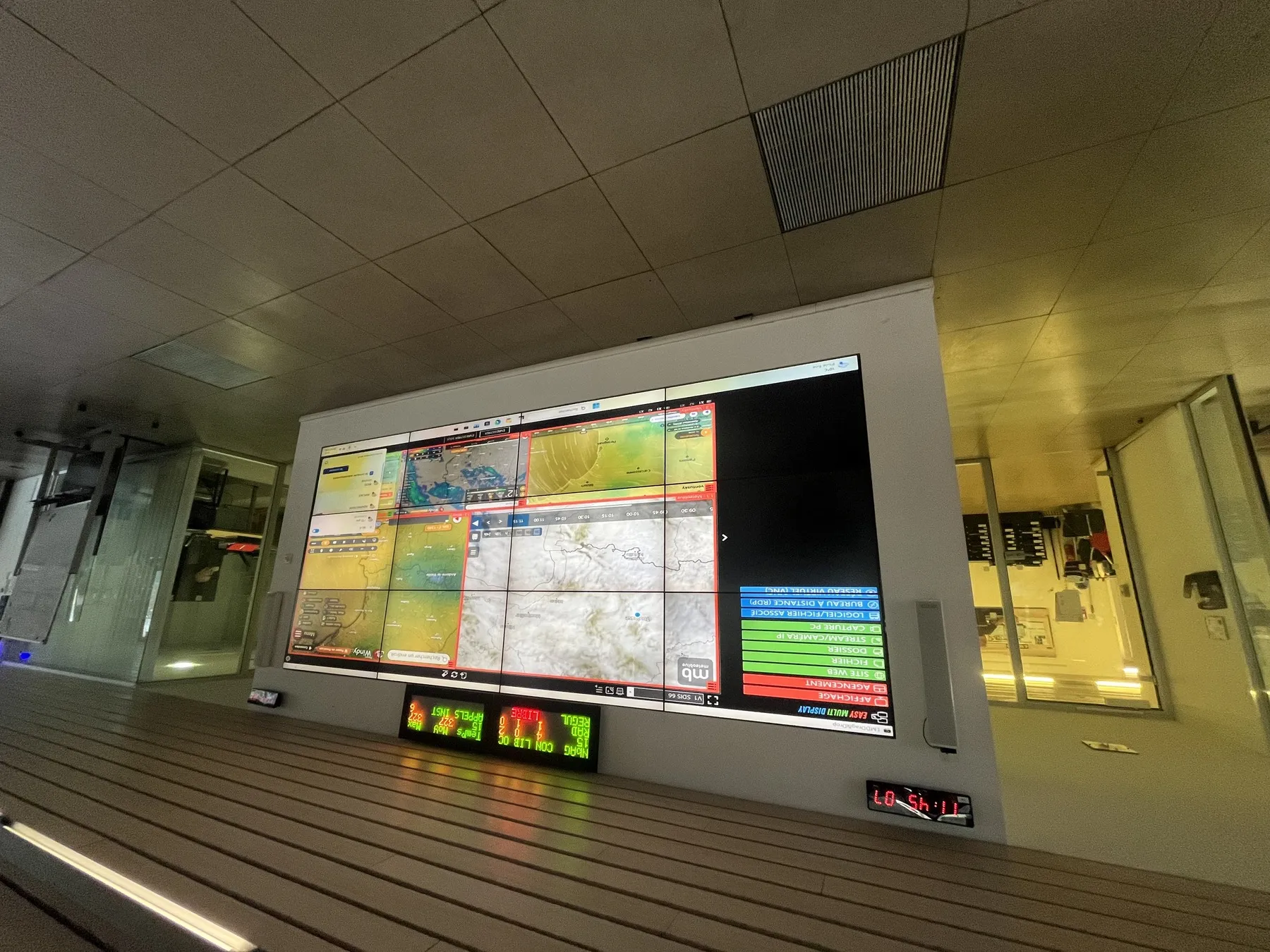
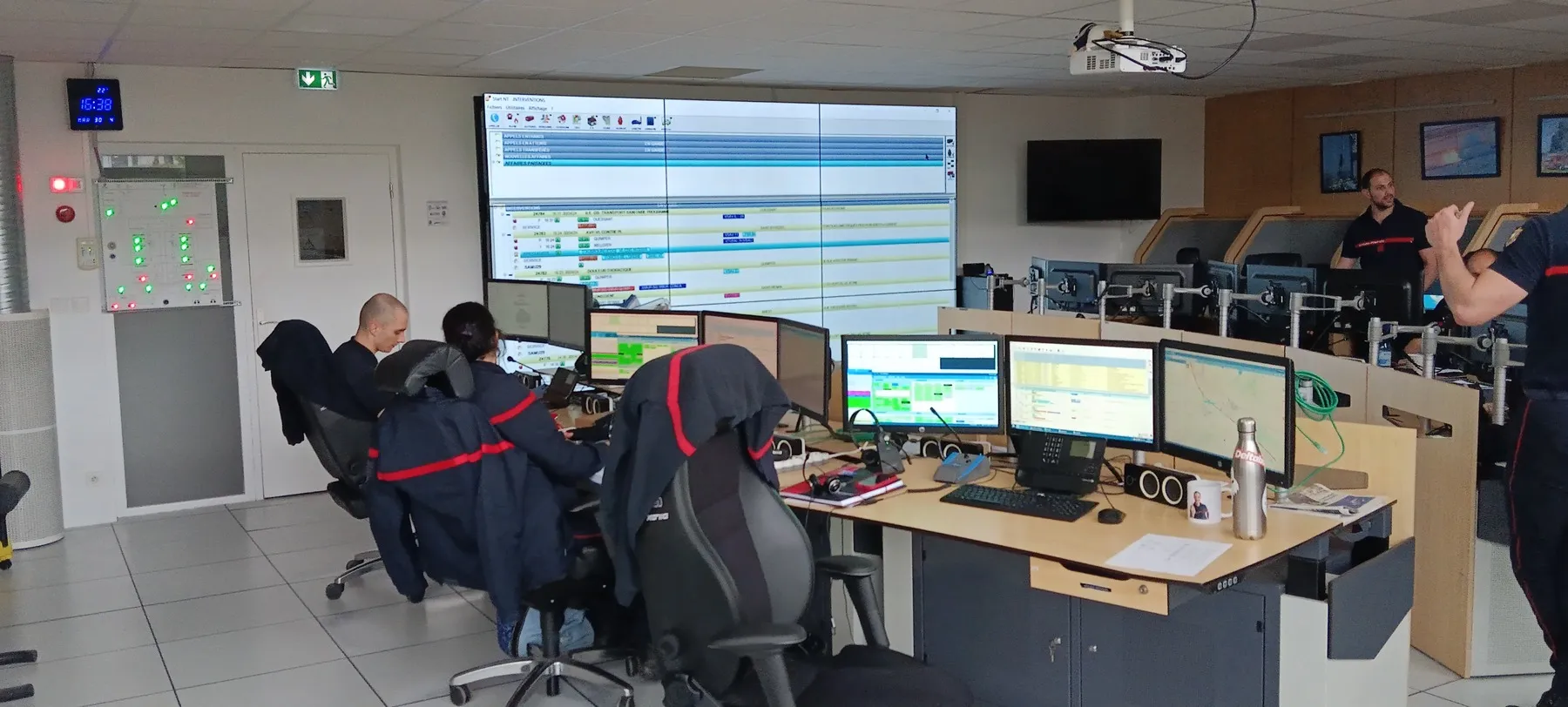

NexSIS, SYSTEL, ARTEMIS
The fire & rescue ecosystem shown on the wall like any other source, with no heavy integration.
Fire & rescue solution · control rooms
Designed with firefighters, for firefighters. EMD brings NexSIS, cameras, drones and maps together on the video wall of your control room, call centre or overflow room - no training, no network between the screens, at a tenth of the price of traditional solutions.
A story born in the field
EMD is not a product dreamed up in a marketing meeting. A fire & rescue service needed to drive its video wall without going through IT at every move. We built the remote control for them. Today, that same building block equips operational rooms all across France.
One fire & rescue service had received a competing quote of €16,000 for the software alone. EMD came in at €480. The rest of the story is being written in 28 fire & rescue services.
"The remote control is what made us decide to sign. It turns the video wall into a truly flexible command centre."
What you drive
The fire & rescue ecosystem shown on the wall like any other source, with no heavy integration.
Live 4K HDMI feeds via capture cards. Hot-plug connection, instant picture on the control-room wall.
Operational maps, water points, vehicle geolocation, intervention sectors.
Urban cameras and partner feeds (town halls, prefecture / local authority) brought together on a single wall.
RDP, VNC: take control of a machine on the operational network without leaving the room.
Cameras and the positions of deployed crews, fed back live from the field.
Maximum security
Between your sources and your walls, everything goes through HDMI and capture cards. No network cable, no feed passing through a sensitive information system. It is the total isolation required in a fire & rescue operational room - the differentiator against all-IP.
And because EMD runs locally, an Internet outage never deprives you of your wall. In crisis management, that is non-negotiable.
NETWORK DOWN?
WALL STILL STANDING
total isolation · HDMI + capture · sovereign
In the field


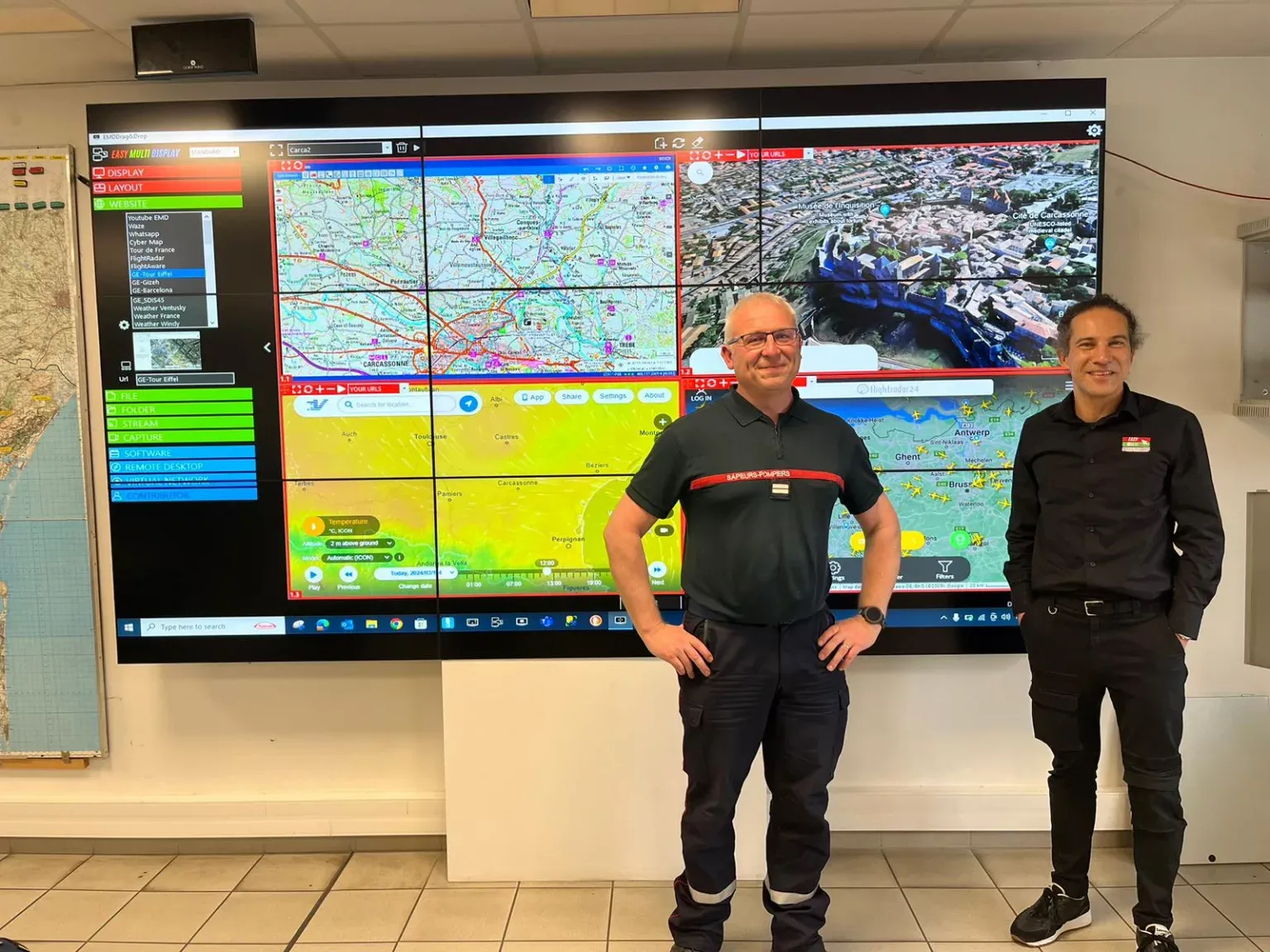

From CODIS to the field
The video wall does not stay in the control room. The same technology equips the mobile command post, the multiservice unit and even the command case carried on your back. From the fixed room to the truck, by way of the bag, it is the same software and the same gestures - nothing to relearn on the day you head out on an intervention.


Case study · SDIS 76
SDIS 76, the fire & rescue service of Seine-Maritime and a long-standing client, first equipped its multiservice unit and its mobile command post. Then, in 2026, it renovated its three operational rooms - CRISE, CODIS and CTA - with touch control, on the hardware already in place. A colonel's words, still famous here: with EMD, the bill is the competitor's quote with one zero less.
Pricing
Where traditional solutions go beyond €30,000. Perpetual licence, paid once, French support, zero subscription. Reuse the hardware you already have - Green IT philosophy.
Frequently asked questions
The questions raised in emergency call centres and control rooms, by the people who use the wall every day and by the people who buy it.
28 French departmental fire and rescue services (SDIS) are equipped, roughly a quarter of the national territory and close to 12 million inhabitants protected day to day. More than 20 operational rooms have been installed: emergency call centres, control rooms, overflow rooms and mobile command posts.
See the reference mapYes, with no heavy integration. NexSIS, SYSTEL and ARTEMIS appear on the wall like any other source: HDMI capture from the operator position, a network stream or a remote desktop. There is no software gateway to commission, no access to request from the dispatch system vendor, and no dependency on their release schedule.
No. Everything runs locally, on the machine driving the wall. No operational data leaves the room, no cloud is involved, and the wall keeps displaying if the site loses its internet link. For an operations centre this is the only coherent architecture: the day the network fails is exactly the day the room has to hold.
In practice: the dispatch system (NexSIS, SYSTEL, ARTEMIS), cameras and drone feeds in 4K HDMI through capture cards, operational mapping and GIS layers (water points, vehicle positions, sectors), urban video surveillance and partner feeds, remote workstations over RDP or VNC, and the cameras and positions of deployed crews sent back from the field by QuickShare.
No training is needed for everyday use. The wall is composed by drag and drop and prepared layouts are recalled with one click, so a night operator alone in the room can take over without a manual. On-site training by our team is still available at €220 for the advanced features.
Yes, and that is the most common case. Several fire and rescue services have refurbished their room by keeping the screens in place and replacing only the end-of-life proprietary controller with a standard PC running EMD. The wall becomes controllable and upgradable again, for a fraction of a full replacement, and without taking the operational room out of service.
Yes. The Server range equips command vehicles and units: one EMD PC drives the screens of the mobile post, captures the operator workstations and handles video conferencing, projection and the outdoor screen. It is delivered configured and installed, with an 8-hour support allowance for the first year. The Seine-Maritime fire service operates a mobile command unit equipped with EMD.
It never leaves the room. EMD hosts nothing, sends nothing to a remote server and requires no online account: the software displays sources that already exist on your network. Nothing is transferred outside the service infrastructure, so there is no processor to declare under GDPR, and the publisher is a French company you can reach directly.
The software starts at €480 excl. VAT, where a competing quotation presented by a fire service reached €16,000 for the software alone. For a complete turnkey room, budget €2,959 excl. VAT for the Eco range (8 PCs on one control screen) and €11,000 to €18,000 excl. VAT for the Server range depending on the number of screens and sources, installation included.
See all pricesOur teams carry out the survey, cabling, configuration and on-site installation, then provide support directly, with no outsourced call centre: you talk to the people who write the software. Easy Multi Display is a French company publishing its own suite, built by two founders with 25 years of experience.
Contact usA no-commitment demonstration, or receive a fire & rescue case study in PDF format.